
How to Tell a Real Basra Pearl
In Rajasthan, “Basra moti” has meant the finest pearl for generations. Today the name is printed on almost anything round and white. This guide covers what you can check yourself, what only a laboratory can prove, and the questions to ask before you spend on any pearl, from us or anyone else.
Real, cultured or imitation?
Basra pearls are natural pearls from the Persian Gulf, formed inside wild oysters with no human help. (We explain the name and history in What Are Basra Pearls?.) Two other kinds of pearl are often sold under the same name:
- Cultured pearls are real pearls grown on a farm, where a bead or tissue is placed inside the oyster to start the pearl. They are genuine, but they are not Basra pearls.
- Imitation pearls are glass, plastic or shell beads with a pearly coating. They are not pearls at all.
So the first question is “real or imitation?”, and the second, harder question is “natural or cultured?”
Five checks you can do at home
These tell a real pearl, natural or cultured, from an imitation. None of them damages the pearl.
- The tooth test. Rub the pearl gently along the edge of your front tooth. A real pearl feels slightly gritty, like fine sand. An imitation feels smooth and glassy.
- Look closely at the surface. Under a magnifier or your phone’s zoom, real pearls show tiny ridges, spots and slight unevenness. A perfectly smooth, identical surface on every pearl is a warning sign.
- Check the drill holes. On an imitation, the coating often chips or peels around the hole, showing glass or plastic underneath. On a real pearl the edge is clean and the layers look continuous.
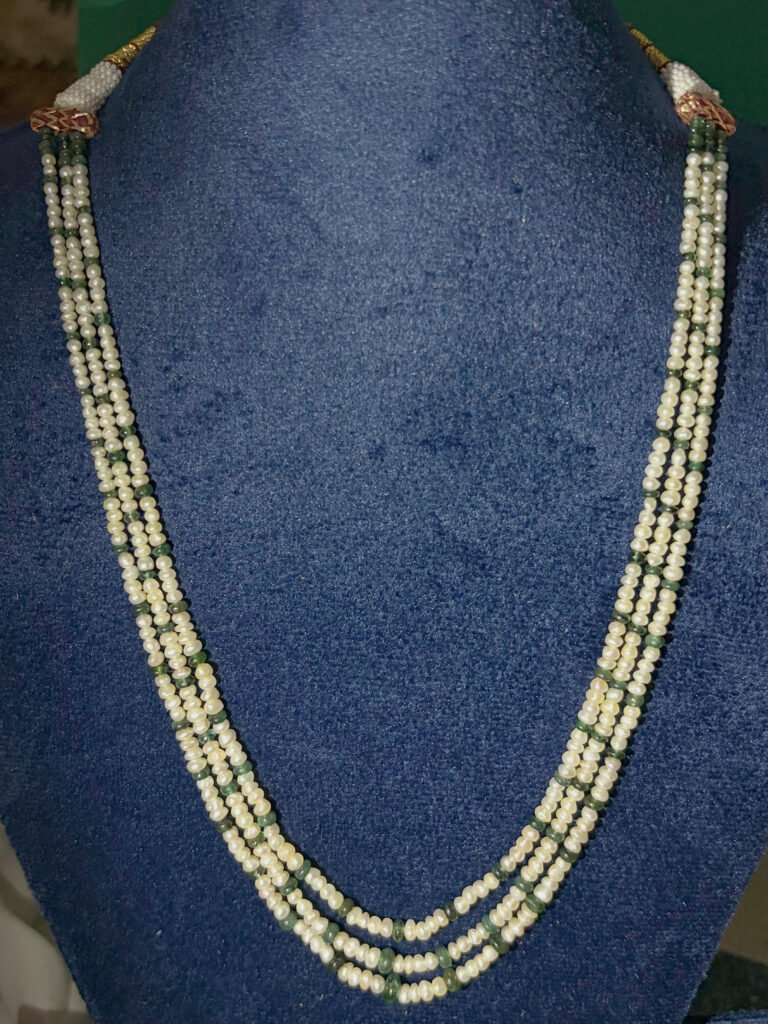
- Compare the pearls in the strand. Natural Basra pearls are rarely perfectly round or perfectly matched. Small, slightly irregular pearls of varying shape are typical of an old natural strand. A strand of large, flawless, identical pearls at a low price is almost never natural.
- Feel the temperature and weight. Real pearls feel cool at first and warm slowly in your hand. Plastic feels warm and light straight away.
Please skip the “fire test” you may see online. Holding a flame to a pearl can ruin a real one.
What only a laboratory can prove
No home test can tell a natural pearl from a cultured one. Both are made of the same nacre, so both pass the tooth test. A gem laboratory uses X-ray imaging to look inside: many cultured pearls show the round bead placed at their centre, while a natural pearl shows growth layers all the way through. (More on this in Natural vs Cultured Pearls.)
If a seller calls a pearl natural, ask whether a lab report is available. For an expensive strand, independent testing is worth its cost.
Five questions to ask any seller
- Are these natural, cultured or mixed? Old strands are sometimes restrung with a few newer pearls.
- What is the total weight in carats, and how much of it is pearl versus gemstone and gold?
- Where did the piece come from, and roughly how old is it?
- Can I see it in daylight on a video call, or in person?
- What happens if a lab later finds something different from what you told me?
A good seller answers all five without hesitation. Once you own a strand, our guide to caring for Basra pearls will keep it at its best.
Basra pearls at Antiqo
Our Basra pieces come from the Kothari family’s holdings in Churu, collected over generations. Each listing gives the carat weight and the stones used, and we tell you plainly what we know about each piece and what we don’t. Ask us about any piece and we will answer all five questions above.
- Basra Pearl and Zambian Emerald Three-Strand Necklace
- Three-Strand Basra Seed Pearl Necklace
- Basra Pearl Necklace with Rubies and Emeralds
- Twisted Basra Pearl Rope Necklace with 20K Gold Clasp
- Basra Pearl and Emerald Five-Strand Necklace
Want to see a piece in daylight before you decide? Message us on WhatsApp for a video viewing, or request a private appointment in Jaipur.