
What Are Basra Pearls?
For centuries, the finest pearls in the world did not come from a jeweller’s farm. They came from the warm, shallow waters of the Persian Gulf, gathered one by one by divers who held their breath and worked the oyster beds by hand. These are the pearls Indian families still speak of with reverence: Basra pearls.
Where the name comes from
Basra, the port city in southern Iraq, was for a long time one of the great trading points for pearls fished across the Gulf, from the waters around Bahrain, Qatar and the Arabian coast. “Basra” became a trade name for natural Gulf pearls in general, rather than a promise that each pearl was found off that one city. Many of these pearls travelled onward to Bombay, which for generations was one of the most important centres for sorting, drilling and trading Gulf pearls before they reached royal treasuries and family jewellery boxes across India.
Natural, not cultured
A Basra pearl is a natural pearl. It formed inside a wild Gulf oyster without any human help, layer upon layer of nacre building up over years around a tiny irritant. No bead was inserted and no farm was involved. That is what makes them so rare today: natural pearl fishing in the Gulf declined sharply in the twentieth century, after cultured pearls arrived on the world market. Every genuine Basra pearl you see today is, in practice, an old pearl with a history behind it.
How Basra pearls look and feel
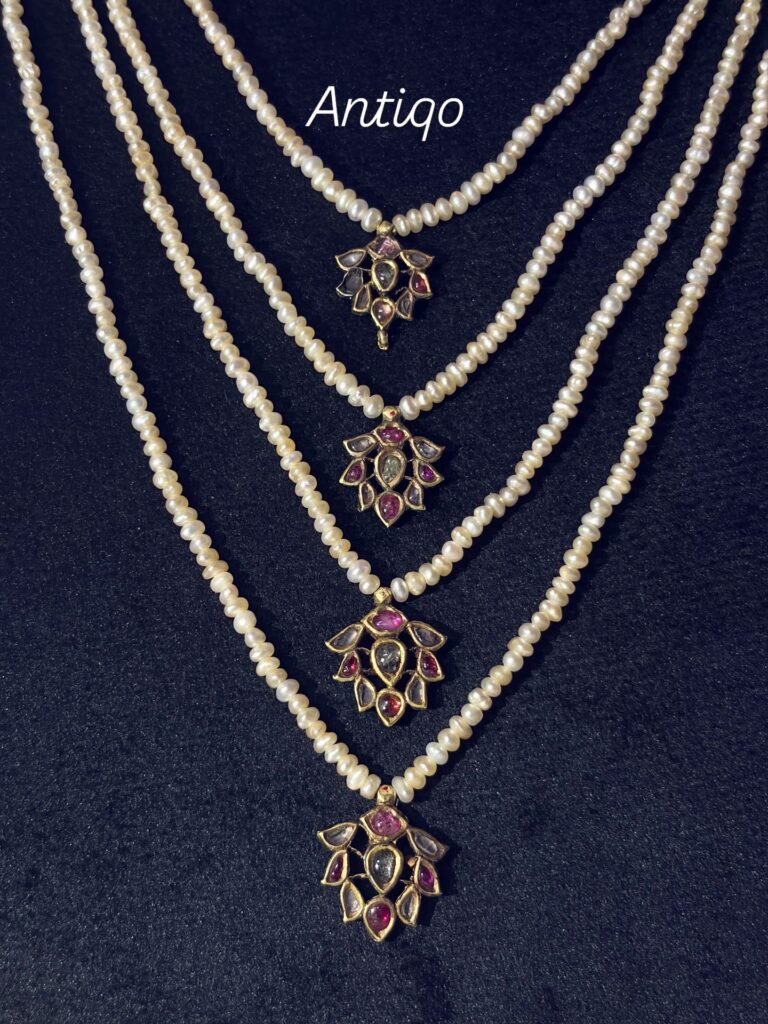
- Lustre: a soft, deep glow that seems to come from inside the pearl, rather than a hard mirror-like shine.
- Colour: usually creamy white with warm or faintly rosé overtones, never a uniform bright white.
- Shape: rarely perfectly round. Slightly baroque, button or drop shapes are typical, and strands often graduate in size.
- Size: often small, sometimes tiny “seed” pearls, because large natural pearls were extraordinarily rare.
Why they matter in Indian jewellery
Basra pearls were set in kundan and polki jewellery, strung into multi-strand necklaces and worn by royalty and wealthy merchant families alike. In many homes, a Basra pearl strand was part of a bride’s trousseau and was handed down from one generation to the next. Their quiet glow suited the warm tones of old gold, and their rarity made them a store of value as much as an ornament.
How to know a pearl is truly natural
Looks alone are not enough. Natural and cultured pearls can appear almost identical to the eye. The reliable way to confirm a natural pearl is a laboratory test, usually X-ray imaging, which shows the pearl’s inner growth structure. A natural pearl shows concentric layers; most cultured pearls reveal an inserted bead nucleus. When you buy a pearl described as natural or Basra, ask whether it comes with a report from a recognised gemmological laboratory.
Caring for an old strand
- Wear pearls last and remove them first: perfume, hairspray and creams can dull nacre.
- Wipe them with a soft, dry cloth after wearing.
- Store them flat, away from other jewellery that could scratch them.
- Have antique strands restrung by a specialist if the silk has stretched or darkened.
At Antiqo
Every pearl piece at Antiqo is described honestly: whether it is natural or cultured, its approximate age, and what testing has been done. If a piece has a laboratory report, we share it; if it does not, we say so. We believe an object deserves more than a date. It deserves a story, and the truth.
Interested in a Basra pearl piece? Explore Basra Heritage or enquire on WhatsApp.
See natural Basra pearl jewellery in our Basra Heritage collection, or message us on WhatsApp to book a video viewing.