The Stories Behind Ravi Varma’s Ramayana and Hanuman Oleographs
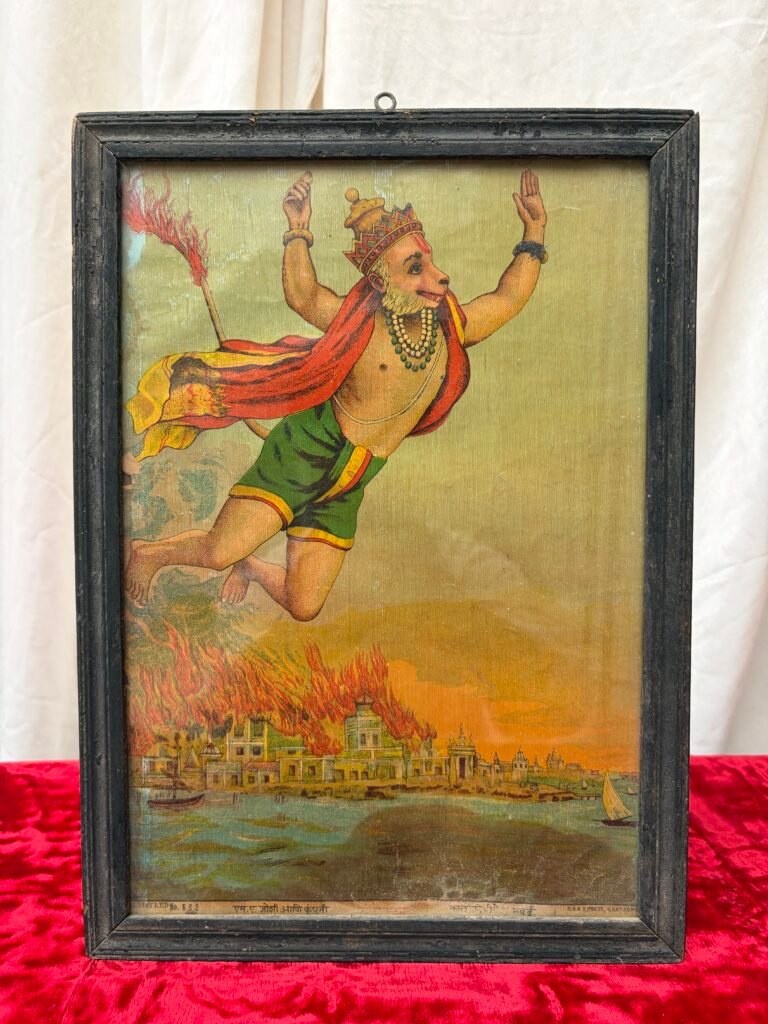
Raja Ravi Varma set up his printing press in Ghatkopar, Mumbai, in 1894, and moved it to Malavli, near Lonavala, in 1899. The press printed oleographs of Hindu gods and goddesses, mostly scenes from the Mahabharata, the Ramayana and the Puranas. The idea was simple: bring these pictures into ordinary homes, at a price ordinary families could pay. The press was sold in 1901 to Fritz Schleicher, a German printing technician, and the oleographs stayed in demand long after Varma’s death in 1906.
A good oleograph therefore does two jobs. It is a piece of Indian printing history, and it tells a story that the family looking at it already knows. Here are some of the stories behind the oleographs we offer. To learn how to recognise an early oleograph, read our collector’s guide to Ravi Varma oleographs.
Sita Swayamvar
In the Ramayana, Sita’s father, King Janaka of Mithila, holds a swayamvar, a ceremony at which a bride chooses her husband. The test is Shiva’s great bow. Many kings fail to even lift it. Rama lifts the bow and it breaks. Sita garlands him, and the wedding follows.
Ram Sagar Darpa Haran
“Darpa haran” means the humbling of pride. Rama and his army reach the shore, and Lanka lies across the sea. Rama prays to Samudra, the ocean, for a way across, but the ocean does not appear. Rama takes up his bow, and Samudra comes before him and offers his help. A bridge is then built across the water.
Lanka Dahan and Dronagiri Maruti
Hanuman is the hero of two of the best-loved scenes. In Lanka Dahan, the demons set fire to Hanuman’s tail, and he uses it to set Lanka ablaze. In Dronagiri Maruti, Lakshmana lies wounded on the battlefield and needs a healing herb that grows far away in the Himalayas. Hanuman cannot tell which plant it is, so he lifts the whole mountain and carries it back.
Ahi-Mahi Vadh and Panchmukhi Hanuman
In later retellings of the Ramayana, the demon kings Ahiravan and Mahiravan carry Rama and Lakshmana away to the underworld. Hanuman follows them, takes the form of Panchmukhi Hanuman with five faces, and defeats the two kings. Panchmukhi Hanuman is worshipped as a protector.
Ram Darbar and Ram Panchayatan
These show Rama enthroned with Sita, Lakshmana and his devoted followers, usually with Hanuman at his feet. It is the picture of Rama’s court after his return to Ayodhya, and many families keep one in their prayer room.
Saraswati
Saraswati is the goddess of learning, music and the arts. Ravi Varma painted her seated with a veena, and her image has long been a favourite for students and for homes of musicians and teachers.
At Antiqo
Every Ravi Varma artwork we offer is carefully authenticated and accompanied by appropriate certification to establish its authenticity.
Browse the whole Ravi Varma Gallery, or message us on WhatsApp to book a live video viewing of any piece.