
How to Identify an Original Antique?
Antique shops, online marketplaces and weekend bazaars are full of things that look old. Some are genuine, many are reproductions, and a few are deliberately made to deceive. Not everything old is antique, and not everything that looks antique is old. Here is how experienced collectors tell the difference.
First, what counts as an antique in India?
Under India’s Antiquities and Art Treasures Act, 1972, an object of artistic or historical interest is generally treated as an antiquity if it is at least 100 years old. Some antiquities must be registered, and antiquities cannot be exported without permission. Anything younger is usually described as vintage: still collectable and often beautiful, but a different category. A trustworthy seller will tell you plainly which is which.
1. Look at the wear, and ask whether it makes sense
Genuine age leaves wear where hands, feet and use naturally touch an object: the rim of a bowl, the handle of a box, the base of a lamp. Artificial ageing tends to be even, everywhere at once, or in places nobody would ever touch. Ask yourself: would a person really have worn it down here?
2. Study how it was made
- Metalwork: old brass and silver were often hand-raised, hammered or cast, with small irregularities. Perfectly uniform machine finishes, modern screws or spot welds are warning signs.
- Glass: older blown glass may show a pontil mark on the base, tiny bubbles and slight unevenness. Very sharp mould seams running all the way to the rim usually point to later production.
- Wood: look for hand-cut joints, tool marks and natural shrinkage across the grain.
- Paintings and oleographs: check the paper, the canvas, the stretchers and the back. The back of an object often tells more truth than the front.
3. Patina cannot be rushed
Patina is the slow change of a surface over decades: the soft glow of old silver, the deep tone of handled brass, the mellowing of wood. Chemically aged surfaces often look flat, powdery or too uniform, and they may rub off. Real patina sits in the surface.
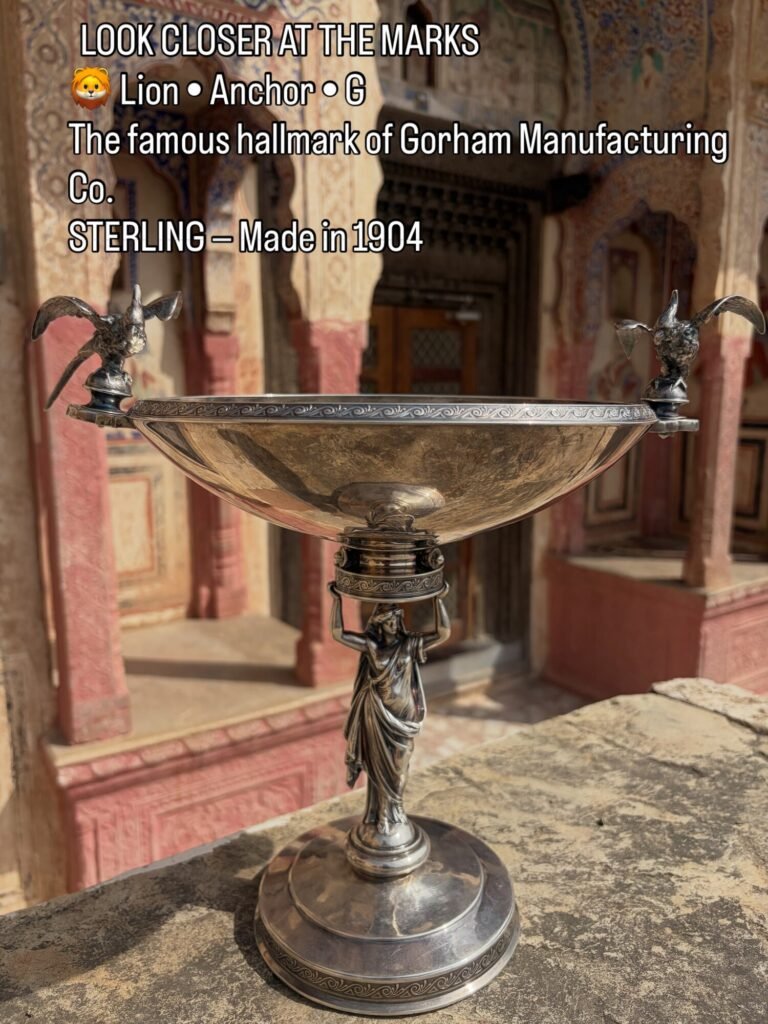
4. Marks, stamps and signatures
Hallmarks, maker’s marks, import stamps and signatures can help date a piece, but they can also be faked. Use them as one clue among many, never as proof on their own. A mark that is too crisp on an object that is otherwise worn should make you curious.
5. Provenance: where has it been?
Provenance is an object’s documented history: who owned it, where it was found, old photographs, invoices, family records. Strong provenance adds both confidence and value. Ask every seller what they know about where a piece came from, and notice whether they answer clearly.
6. When in doubt, ask an expert
For valuable pieces, especially pearls, gemstones, coins and paintings, independent testing or an expert opinion is worth far more than it costs. Laboratory reports, metal testing and specialist appraisals turn a guess into knowledge.
The Antiqo way
Every object at Antiqo is studied through the same six steps: Origin → History → Rarity → Identification → Provenance → Collection. We describe condition honestly, photograph flaws instead of hiding them, and tell you clearly whether a piece is antique or vintage. Because at Antiqo, we believe an object deserves more than a date. It deserves a story.
Have a question about a piece? Ask us on WhatsApp before you buy.
Every Antiqo piece is chosen with these checks in mind. Browse our collections, or message us on WhatsApp to book a video viewing.