
The Hansli Haar: Meaning, History and How to Wear It
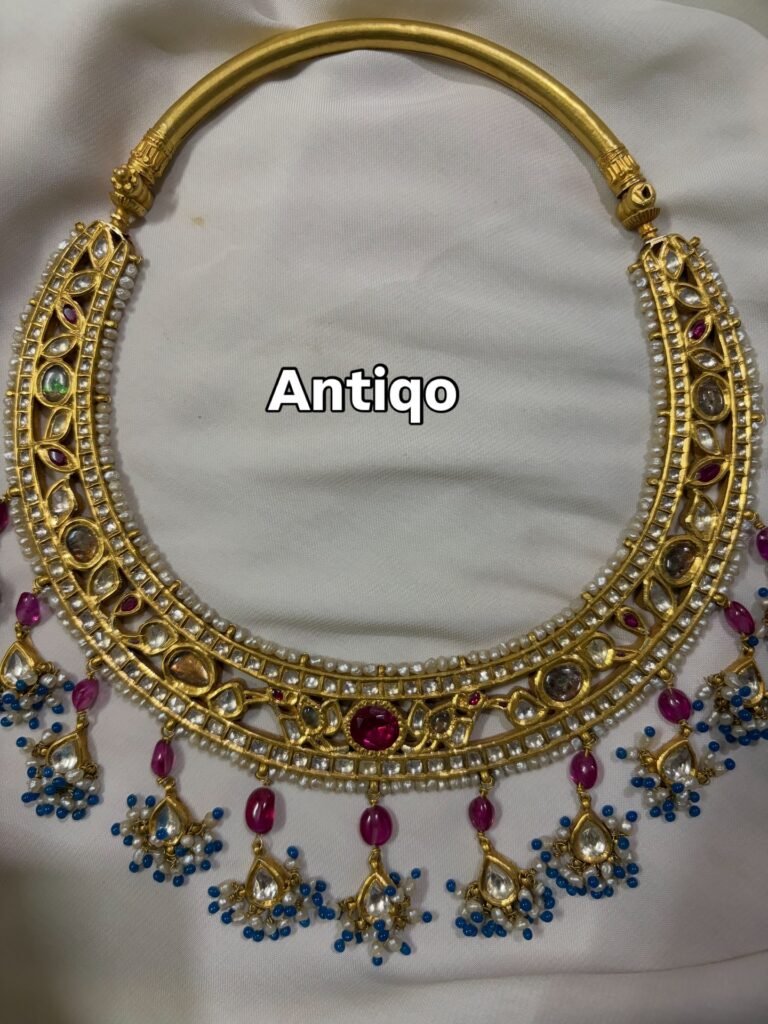
Few Rajasthani ornaments are as instantly recognisable as the Hansli: a rigid, curved collar that sits at the base of the neck. Many of you asked about it after our Hansli Haar reel, so here is what this necklace is, where it comes from and how to wear it.
What the name means
“Hansli” comes from hansuli, the Hindi word for the collarbone, because the necklace rests along it. You will also see it written as hasli or hansdi. Unlike a haar that hangs loose, a Hansli holds its own curved shape, opening at the back so it can be slipped on.
Who wore the Hansli
The Hansli has been worn across Rajasthan and Gujarat for generations, by women and men alike, and in many communities. In villages, solid silver Hanslis were everyday jewellery and a family’s portable savings. In merchant and royal households, the same form was made in gold and set with stones for ceremonies and weddings. Smaller Hanslis were also made for children.
That range is why antique Hanslis vary so much: a heavy, plain silver torque from a village and a fine Jadau collar from a haveli are both true Hanslis.
How a Jadau Hansli is made
Jadau is Rajasthan’s traditional technique of setting stones in gold without claws. The craftsman builds the gold frame, cuts channels for the stones, and presses in layers of pure, softened gold (kundan) to hold each stone in place. The back is often decorated with meenakari enamel, so the piece is finished on both sides. A good Jadau Hansli is heavy in the hand, sits evenly on the collarbone and shows careful, symmetrical setting. (We go deeper into the technique in Jadau and Kundan: How Royal Indian Jewellery Was Made.)
How to tell an old Hansli from a new one
- Wear in the right places: softened edges and a gentle polish on the inner curve, where it rested on skin for years.
- Hand-made joins: slight irregularities in the hinge, clasp and setting, rather than identical machine-made parts.
- Enamel and stones: old meenakari may show small, natural losses; old stones are often flat-cut polki rather than modern brilliant cuts.
- No modern marks: most older pieces carry no modern hallmark. That alone proves nothing, so ask the seller what they know of the piece’s history.
A new piece made in the old style is not a bad thing, but it should be sold as new.
How to wear a Hansli today
- For a bride: let the Hansli sit high at the collarbone and layer one longer necklace, such as a Rani Haar or a pearl strand, below it. Keep earrings in the same metal and stones.
- With a saree: a Hansli works best with a high or boat neckline, where it frames the face.
- With modern clothes: a single silver Hansli with a plain kurta or shirt is striking on its own. Don’t add another necklace.
- Fit: turn your head side to side when trying one on. It should sit flat and not press on your throat.
The Hansli at Antiqo
Our Jadau Kundan Hasli with Pearl Drops is an original Rajasthani piece from the family collection. For the full bridal layering, pair it with the Jadau Kundan Rani Haar with Basra Pearl Strands.
Message us on WhatsApp to see either piece on a video call, or request a private appointment in Jaipur.